
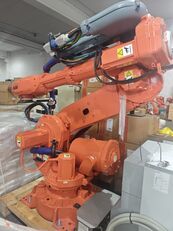
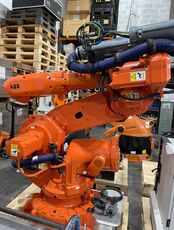
ABB IRB 7600 325/3.10 340/2.80 400/2.55 500/2.55 IRC5 industrial robot


If you decide to buy equipment at a low price, make sure that you communicate with the real seller. Find out as much information about the owner of the equipment as possible. One way of cheating is to represent yourself as a real company. In case of suspicion, inform us about this for additional control, through the feedback form.
Before you decide to make a purchase, carefully review several sales offers to understand the average cost of your chosen equipment. If the price of the offer you like is much lower than similar offers, think about it. A significant price difference may indicate hidden defects or an attempt by the seller to commit fraudulent acts.
Do not buy products which price is too different from the average price for similar equipment.
Do not give consent to dubious pledges and prepaid goods. In case of doubt, do not be afraid to clarify details, ask for additional photographs and documents for equipment, check the authenticity of documents, ask questions.
The most common type of fraud. Unfair sellers may request a certain amount of advance payment to “book” your right to purchase equipment. Thus, fraudsters can collect a large amount and disappear, no longer get in touch.
- Transfer of prepayment to the card
- Do not make an advance payment without paperwork confirming the process of transferring money, if during the communication the seller is in doubt.
- Transfer to the “Trustee” account
- Such a request should be alarming, most likely you are communicating with a fraudster.
- Transfer to a company account with a similar name
- Be careful, fraudsters may disguise themselves as well-known companies, making minor changes to the name. Do not transfer funds if the company name is in doubt.
- Substitution of own details in the invoice of a real company
- Before making a transfer, make sure that the specified details are correct, and whether they relate to the specified company.
Seller's contacts

 +34 600 98 ...
Show
+34 600 98 77 48
+34 600 98 ...
Show
+34 600 98 77 48

 Spain
Spain


 Spain
Spain


 60 kg
Spain
60 kg
Spain


 5 kg
Spain
5 kg
Spain


 125 kg
Spain, Barcelona
125 kg
Spain, Barcelona


 Spain, Barcelona


 Spain, Barcelona


 Spain, Barcelona


 120 kg
Spain
120 kg
Spain
 500 kg
Spain
500 kg
Spain


 Industrial robot parts


The ABB IRB 7600 industrial robot series represents the heaviest line of heavy-duty industrial robots engineered by ABB. Designed explicitly for high-capacity, heavyweight applications across diverse sectors, these multi-axis robots are commonly utilized for managing substantial fixtures, turning automotive bodies, lifting engines, manipulating heavy foundry or forge parts, tending machine cells, and handling complex, bulky pallet layouts.
The entire product line is operated by the fifth-generation IRC5 M2004 controller, which incorporates several advanced technologies to optimize production efficiency. It utilizes the FlexPendant, an interface distinguished by a clean, color touch screen and an ergonomic 3D joystick designed for intuitive user interaction and custom application support. System functionality is driven by the RAPID programming language, which balances programmatic simplicity with deep, structured flexibility suitable for demanding shop-floor process tasks. For network integration, the IRC5 controller acts as a compliant node supporting state-of-the-art industrial I/O fieldbuses, remote disk access, sensor interfaces, and socket messaging protocols. Advanced motion control architecture dictates the physical performance across the 6-axis configurations.
Across the broad spectrum of the ABB IRB 7600 lineup, specific capacities vary based on the model variation. The maximum load capacity scales progressively from 325 kilograms up to 340 kilograms, 400 kilograms, and ultimately 500 kilograms. Concurrently, the maximum reach metrics shift depending on the specific payload structure, measuring 3100 millimeters for the 325-kilogram variant, 2800 millimeters for the 340-kilogram model, and 2550 millimeters for both the 400-kilogram and 500-kilogram variations. Regardless of the load and reach parameters, every model maintains a consistent high-precision repeatability rating of 0.3 millimeters.
These capabilities allow the variant family to fulfill a dynamic range of automated industrial deployments. The robot series is widely used for spot welding, press tending, palletizing, loading and unloading parts, general machining, advanced material handling, part polishing, measurement, and precision assembly. Certain high-payload variants are further specialized to handle automated arc welding, Nd-Yag laser welding, industrial gluing and adhesive bonding, precise plasma cutting, laser cutting, and other complex manufacturing environments.